Turkey's Geopolitical Future
Turkey's geopolitical future is a 3-track contest: Ankara is simultaneously consolidating its role as NATO's 2nd largest military power in the alliance, rebuilding the Turkish state's claim as the bridge between Europe and the Middle East, and forcing the countries of its neighbourhood to negotiate with it from a position of strength. That 3-track strategy is not a plan Ankara has finished executing; it is the structure of the problems Turkey now inherits, and of the choices it will make over the next 2 decades. The next section maps the terrain those 3 tracks cross, and the rest of this page follows each track to its current endpoint.
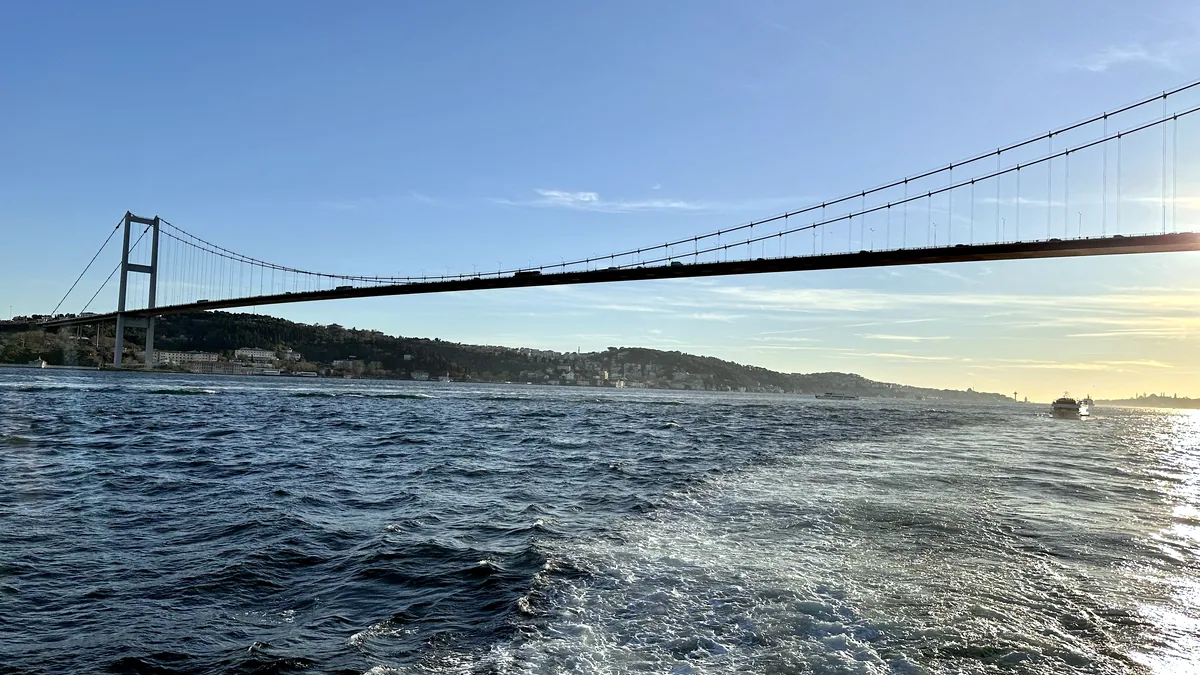
The terrain begins with geography. Turkey sits at the junction of 3 regions, Europe, the Middle East and Eurasia, and it controls the only sea routes that connect the Black Sea to the Mediterranean. The 2 straits at Istanbul, the Bosporus and the Dardanelles, pass roughly 3% of the world's seaborne trade, and Russia's Black Sea fleet has no legal path to the open ocean except through them. Add to that the fact that Turkey borders 8 countries, from Greece in the west to Iraq and Iran in the south, and the country's foreign policy is permanently a balancing act: every shift in one of its neighbours is felt in Ankara within days, not years.
That balancing act has a hard edge on its eastern flank, and that edge is the Kurdish issue. The Kurdish Question in Turkey is the oldest unresolved border problem in the country, stretching back to the 1920 Lausanne Treaty that fixed Turkey's borders after the collapse of the Ottoman Empire. The question is not settled by one side or the other, it is managed, and its management spills across borders into Iraq, Syria and Iran, where Kurdish communities in all 3 countries give Ankara, Baghdad, Damascus and Tehran a shared and often contradictory interest in the same 1.8 million square kilometres of mountainous territory. For Turkey, that shared interest is at once a diplomatic lever and a permanent source of tension, and it shapes almost every other decision in the country's foreign policy.
The Strategic Position Turkey Holds in 2026
Today's strategic position of Turkey rests on 4 assets, and each one is more valuable than it was 20 years ago. The first is the military: with roughly 350,000 active personnel, the Turkish Armed Forces are the 2nd largest in NATO after the United States, and they are backed by a domestic defence industry that now produces its own drones, the TAI T-90 tanks, and the Altay main battle tank. The 2nd asset is the straits, which Turkey administers under the 1936 Montreux Convention, a treaty that gives it a rare legal card over naval traffic in wartime. The 3rd is its position as a logistics hub for both NATO and, since 2016, for its own independent partnerships, including the 2020 defence agreement with Ukraine. The 4th is population and economy: with 86 million people and a GDP of about 1 trillion US dollars, Turkey is too large for any regional rival to ignore.
Each of those 4 assets points in the same direction. Turkey is not a peripheral state that reacts to events in the region; it is a core state whose consent, or refusal, is a precondition for most major moves in the Middle East and on the Black Sea. The question is not whether Turkey is important; the question is what it does with that importance next, and which of the 4 assets it leans on hardest.
The Geopolitical Problems Turkey Faces Right Now
The problems Turkey faces right now cluster into 3 categories, and they are not independent of one another. The first category is border and security problems: the Kurdish Question described above, the refugee issue with 3.6 million registered Syrians, and the unresolved maritime boundary disputes with Greece over islands and exclusive economic zones in the Aegean and Eastern Mediterranean. The 2nd category is alliance friction: Turkey's 2019 purchase of Russia's S-400 air defence system put it at odds with its NATO partners, who excluded it from the F-35 fighter jet programme in 2019, a rift that has narrowed but not closed. The 3rd category is economic exposure: a lira that has lost more than 80% of its value against the US dollar between 2018 and 2026 makes every large purchase, from jets to energy, politically expensive.
These 3 categories interact in a specific way. Economic weakness limits how much Ankara can spend on military hardware, which in turn limits its leverage in alliance negotiations, which in turn pushes it to seek cheaper partners, and cheaper partners are usually the very rivals it is trying to balance. That loop is the structural problem behind most of Turkey's current foreign policy, and it is the reason Ankara's 2026 posture looks more transactional, not more ideological, than it did 5 years ago.
The 3 Tracks of Turkey's Future Geopolitics
Turkey's future geopolitics will play out along 3 tracks, and the country is currently running all 3 in parallel. Track 1 is the NATO track: Ankara is working to repair the S-400 rift and to re-enter the F-35 programme, which would restore its standing as a core alliance member and bring an estimated 40 billion US dollars in defence procurement over the coming decade. Track 2 is the regional power track: Turkey is deepening its influence in Iraq, Syria, Libya and the Caucasus, where it has troops in 3 of those 4 countries, and it is positioning itself as the country the West has to consult on any deal involving the region's Kurdish communities. Track 3 is the Eurasian track: Ankara is building a stronger economic and energy partnership with Russia, whose gas and oil flow through Turkish pipelines, while at the same time courting China and the Gulf states for trade and investment.
How the 3 Tracks Interact
How the 3 tracks interact is the real story of Turkey's geopolitics in the next decade, because they pull in different directions. The NATO track asks Turkey to distance itself from Russia; the Eurasian track asks it to keep the Russian energy relationship intact. The regional power track asks Turkey to project force into Syria and Iraq; the NATO track asks it to keep that projection inside alliance coordination. Ankara's 2026 answer to that tension is a doctrine of calibrated ambiguity: it gives each partner just enough reassurance to keep the relationship open, and just enough independence to keep its options open. That doctrine worked in 2020 when Turkey brokered a ceasefire in Nagorno-Karabakh, and it is being tested in 2026 as the S-400 file moves through Washington and Ankara at the same time.
What the Kurdish Question Means for the Future
What the Kurdish question means for the future of Turkey's geopolitics is that it will remain the single most consequential domestic issue with cross-border consequences for at least the next 2 decades. The 2019 death of the PKK's leader Abdullah Ocalan was not, as some analysts expected, the end of the armed struggle; the PKK's 40,000-member organisation in the 1990s has shrunk, but the political question it represents, the status of roughly 15 to 20 million Kurds in Turkey, has not changed. The 2024 and 2025 rounds of talks between Ankara and Ocalan's successor, plus the PKK's 2025 decision to begin disarming in Syria, opened a window that did not exist in 2015. Whether that window closes again depends on 2 things: whether the Turkish government can deliver economic results that make the Kurdish east feel the peace dividend, and whether the Kurdish Regional Government in Iraq and the Kurdish forces in Syria remain willing to coordinate with Ankara rather than with their other patrons.
Where Turkey Stands in the Global Geopolitical Landscape
Where Turkey stands in the global geopolitical landscape is as a pivot state in a 3-way contest between the US, Russia and China, and that position is more valuable to all 3 than it has been at any point since the 1990s. The US needs Turkey's air bases, its strait access and its intelligence partnership. Russia needs Turkey's mediation role and its energy market. China needs Turkey as a gateway for the Belt and Road projects into Europe and the Middle East, and Turkey hosts a 14 billion US dollar rail link project as part of that network. The problems in the world that the great powers are currently managing, the war in Ukraine, the instability in Syria, the competition in the Indo-Pacific, all of them touch Turkey at some point, and Turkey knows it. That knowledge is what lets a country of 86 million people punch at the weight of a great power without claiming the title.
The 2026 landscape is therefore defined by 1 fact: Turkey is not choosing between the West and the East, it is pricing both, and the price it extracts is the price of its strategic position. The 3 tracks will not converge into one; they will keep running in parallel, and the next 10 years will be measured by how much Ankara can hold all 3 open at once, and how much of its 86 million people's future gets spent to keep them open.